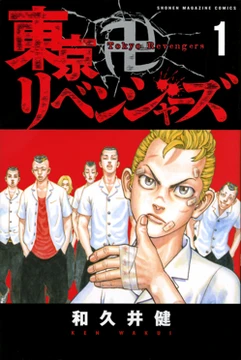
Tokyo Manji Gang
Black leather, roaring engines, and a brotherhood that bends time itself to keep its promises.

The Tokyo Manji Gang, universally known as Toman, is the central biker gang of the Tokyo Revengers universe. Born from the vision of its founder Manjiro Sano, Toman grew into one of the most feared and respected motorcycle crews in Tokyo, united by a code of brotherhood, loyalty, and an almost spiritual reverence for the road. At its apex, the gang commanded the streets with a charismatic blend of raw combat prowess and genuine camaraderie, making it the gravitational center around which the entire story orbits.
Toman is not merely a setting or backdrop; it is the emotional heart of the narrative. Every major arc—time travel, the Blackening, the Bonten war, the shattering of bonds—flows from the relationships forged within its ranks. For fans, Toman represents the bittersweet ideal of a family built on fists, engines, and the promise that no member will be left behind.
- Type
- Biker gang
- Territory
- Tokyo, Japan
- Founder
- Manjiro Sano (Manji)
- De facto leader
- Mikey
- Vice President
- Chifuyu Matsuno
- Notable member
- Takemichi Hanagaki (protagonist)
- Primary rival
- Bonten
Lore & Background
Toman was built on a simple, almost naive philosophy: that a gang should be a place where outcasts find a home. Manjiro Sano, the gang's founder, instilled that ethos from the very first day, gathering misfits under a shared banner and a shared set of rules. The gang's identity is inseparable from its motorcycles—each member's bike is an extension of their soul, and the collective thunder of their engines rolling through Tokyo's backstreets is as much a cultural signature as any tattoo or uniform.
Over time, the gang's power structure crystallized around Mikey, whose unmatched fighting ability earned him the title of the gang's "King." While Chifuyu handled the day-to-day management, diplomacy, and territorial negotiations, Mikey embodied the gang's spirit in the most visceral way: he was the wall no rival could break. This duality—the administrator and the warrior—gave Toman a stability that lesser gangs lacked, but it also created a fragile dependency. When Mikey's mind began to fracture, the entire structure trembled.
The gang's visual language is deceptively simple. Black leather jackets bearing the Toman insignia, clean-cut hair or deliberately styled cuts, and the ever-present motorcycles create a silhouette that is instantly recognizable in any crowd. There is no ostentation; the power is in the unity, the synchronized movement, the way a dozen riders can stop in unison and the street goes silent. It is this quiet, disciplined menace that sets Toman apart from the chaos of rival crews.
In Their Own Story
The rain had just stopped when the first engine roared to life. Takemichi wiped the water from his forehead and looked up the narrow alley in Shinjuku, where seven black jackets stood in a loose arc, their bikes idling like sleeping beasts. Mikey sat cross-legged on the rear fender of his motorcycle, eyes half-closed, jaw set in that way that meant he was thinking about something no one else could see. Chifuyu adjusted his glasses and checked his phone, already three messages ahead of whatever argument was about to start. Baji spat on the wet pavement and grinned. "You're all too quiet," he said, and the tension broke like a wave. They rolled out together, a single black river cutting through the neon-lit city, and for a few blocks the only sound was the syncopated thunder of engines and the distant wail of a siren that was not, thank God, for them.
Reader's Guide
Toman was founded by Manjiro Sano, who gathered a group of young outcasts in Tokyo and built a biker gang on principles of mutual protection and loyalty. Manji eventually stepped back from active command, and leadership passed to a council of Vice Presidents headed by Chifuyu Matsuno, while Mikey rose to the position of the gang's strongest fighter and spiritual "King."
Key members in rank order: Mikey (de facto leader, strongest fighter); Chifuyu Matsuno (Vice President, chief administrator); the remaining Vice Presidents including Baji Keisuke, Draken (Ryuji Hanagaki), and others who form the gang's executive core; Takemichi Hanagaki, a lower-ranking member and the story's protagonist; and a wider roster of riders who fill out the ranks.
Territory and visual identity: Toman operates across Tokyo, with strong presence in the Shinjuku and Shibuya districts. Members wear black leather jackets bearing the Toman insignia, ride customized motorcycles, and maintain a clean, disciplined appearance that contrasts with the messier aesthetics of rival gangs. Territory is marked less by painted walls and more by the simple fact of their presence—the synchronized roll of engines, the black jackets in a group, the unbroken chain of riders.
Rise and fall: Toman grew from a small crew into a dominant force through Mikey's combat dominance and Chifuyu's strategic management. Their peak came during a period of relative peace and internal cohesion. The fall was triggered by the "Blackening"—a psychological collapse in Mikey that fractured the gang's unity—compounded by the open war with the rival gang Bonten. Internal trust eroded, alliances shifted, and the brotherhood that defined Toman was tested to its breaking point. Rivalries with Bonten and other Tokyo gangs, combined with the time-displacement events that drive Takemichi's journey, ultimately reshape the gang's fate in ways that echo through every member's life.
Did You Know?
- Toman's identity is built around motorcycles rather than a single fixed headquarters; the gang's "home" is the road itself, and their collective presence on a street is their primary territorial marker.
- The duality between Mikey's raw, almost animal fighting power and Chifuyu's methodical, rule-based management creates a leadership structure where the gang's greatest strength is also its most vulnerable point.
- Takemichi's time-displacement ability—being sent back roughly a decade—means he experiences Toman's history from the inside, making him both a member and a witness to events he has already seen unfold.
- The gang's code emphasizes that no member is expendable; this principle is what makes the Blackening and the Bonten war so devastating, because every loss is a personal betrayal of the founding ethos.
More in Factions & Groups
Elsewhere in the Tokyo Revengers universe
Spotted an error? Know more?
This is a living reference — every entry is fact-audited, and reader corrections feed straight into our audit queue. Suggest an edit · See this site's audit record