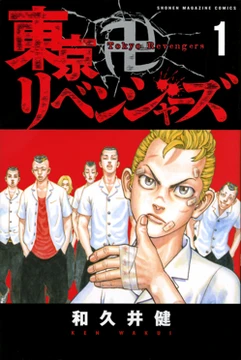
Time Travel
One punch to the face, and the whole world rewinds to the day you were still a kid.

Time Travel is the defining supernatural phenomenon of the Tokyo Revengers universe — a curse-like mechanism whereby a person struck in the head is violently yanked backward through time, landing in their own past. It is not a skill, a weapon, or a gang ability; it is a recurring, involuntary event that reshapes the entire narrative arc of the series and turns the streets of Tokyo into a palimpsest of altered timelines. At its core, Time Travel is what makes Takemichi Hanagaki — a timid, out-of-shape adult who never fit in — into the unlikely hero who repeatedly rewinds his life to protect the people he loves. The phenomenon is not limited to him alone; other characters are swept backward as well, creating cascading consequences that ripple through the Tokyo Manji Gang, the Bonten, and every faction caught in the crossfire of a boy who simply wanted his friends to be safe.
- Temporal range
- Middle-school past to adult present (spanning exactly 12 years, 2005 to 2017)
Lore & Background
In the Tokyo Revengers world, time does not flow in a single, unbroken river. For certain individuals, a sharp impact to the skull acts as a rupture in the current, flinging their consciousness — and their physical body — back to a specific point in their own youth. Takemichi's first and most consequential rewind drops him onto a train platform, where the impact of an oncoming train sends him back into the body of his fourteen-year-old self. The past he returns to is not a sterile, unaltered memory; it is a living, mutable timeline that responds to his choices and the choices of everyone around him. The phenomenon carries a deeply personal weight. It does not send a traveler to an arbitrary date; it anchors them to a formative era of their own life, the period when their identity was still being forged. This is why the time-traveling characters are always thrust back into the world of delinquent gangs, school corridors, and the raw, unfiltered loyalty of adolescence. The past is not a museum — it is a battlefield where the present was built, and every alteration ripples forward into a "present" that may no longer resemble the one the traveler left behind. Over the course of the story, Time Travel becomes less a simple rewind and more a tangled web of overlapping timelines, paradoxes, and characters who remember versions of events that "should not" have happened. The curse does not discriminate by strength or status; it strikes those whose head takes a blow at the wrong moment. Notably, in the final confrontation, Mikey reveals that Shinichiro stole the time-leap ability from a homeless man — it was not his own innate power. What the phenomenon demands of its victims is not power, but the willingness to keep trying, again and again, even when the timeline keeps resetting the stakes.
In Their Own Story
The alley behind the convenience store smelled of rain and cheap cigarette smoke. Takemichi stood with his back against the cold brick, his adult face swollen, his vision swimming in grey. Across from him, the figure he had just tried to stop raised a fist. The punch connected — a dull, bone-deep crack — and the world folded. He was fourteen. His sneakers were scuffed. The school uniform hung loose on his smaller frame. Somewhere behind him, the distant blare of a train crossing sounded like a countdown. He could feel the ghost of the adult's bruise fading in his jaw, replaced by the clean, aching nothing of a kid's face. He looked up. The sky was the same grey it had always been, but the street was different. The shop signs were older. The gang members he had lost were still walking, still alive, still arguing about nothing with the terrible certainty of people who don't yet know what they'll lose. Takemichi swallowed. His hands were shaking. He had done this before. He knew the rhythm of it, the sick lurch of the world stitching itself back together around him. He straightened his spine, pushed off the brick wall, and started walking toward the school gates. Again. Always again.
Reader's Guide
What it does: Time Travel yanks a person backward through time to a specific point in their own past, typically their middle-school or early-adolescent years. The traveler's body, memories, and consciousness are all transported; they arrive as their younger self but with the knowledge of everything that came after. How it works in-world: The trigger is physical — a punch, a blow, or some form of trauma to the head. There is no incantation, no device, no ritual. The moment impact lands, the world around the victim dissolves and reassembles at the earlier point in time. The traveler can then act, speak, and interact with the past as a living, changeable timeline. Returning to the "present" also appears to require another triggering event, creating a loop rather than a one-way trip. Who is affected: Takemichi Hanagaki is the most frequent and central time traveler, but the phenomenon is not exclusive to him. Other characters across the story are swept backward as well, suggesting the mechanism is not tied to a single individual's body or will. It strikes without regard to strength, allegiance, or intent. What it costs: Every rewind rewrites the timeline. People who were saved may still die in a different way. Allies may become strangers. The traveler carries the memory of every version of the world they have seen, which becomes its own kind of burden — the weight of knowing what could be, while watching it slip away again.
Did You Know?
- Takemichi's first time leap is triggered when he is pushed onto a subway platform and about to be hit by a train — the impact sends him twelve years back to 2005, his middle school years.
- Naoto initially deduces that hand-holding triggers Takemichi's time leaps, but this is a misunderstanding — the actual trigger is always a physical impact to Takemichi's head, not hand-holding.
- In the final confrontation, Mikey reveals that Shinichiro stole the time-leap ability from a homeless man — he did not possess it himself.
- Takemichi and Mikey do not time-leap together simply by holding hands; the trigger is a physical impact to Takemichi's head, and Mikey's consciousness is pulled along as a passenger.
Frequently Asked Questions
What is Time Travel in Tokyo Revengers?
Time Travel is the series' central supernatural mechanism — a curse-like phenomenon that yanks a person backward into their own past. It isn't a learned ability or a gang power; it's an involuntary event that drives the entire plot.
What triggers Time Travel?
A physical blow to the head — typically a punch or strike to the face — is what sends the victim tumbling backward through time. There's no incantation, no device, and no conscious decision involved; the trauma itself is the sole catalyst.
Can Takemichi choose when to time travel?
No. Every rewind in the story is triggered by someone landing a hit on his head, so he has zero control over when the event occurs. This makes his heroism all the more desperate, since he's essentially at the mercy of whatever violence strikes his skull.
How far back in time can Time Travel send someone?
In Takemichi's case the rewinds span roughly fifteen years, pulling him from his adult present back into his middle-school days. Different rewinds can land him in different moments within that window rather than a single fixed point.
Does Time Travel only affect Takemichi?
While Takemichi is the primary subject who physically experiences the rewinds, the altered timelines ripple outward and reshape the lives of nearly every character he encounters. The phenomenon effectively turns the whole cast's history into a mutable draft rather than a fixed record.
More in Powers & Artifacts
Elsewhere in the Tokyo Revengers universe
Spotted an error? Know more?
This is a living reference — every entry is fact-audited, and reader corrections feed straight into our audit queue. Suggest an edit · See this site's audit record