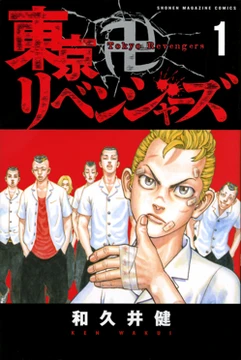
Rindo Koyama
The shaking hands that still raise a fist for the gang.

Rindo Koyama is a lower-ranking member of the Tokyo Manji Gang (Toman) who appears during the early Toman arc of Tokyo Revengers. He is a supporting character who embodies the everyday, ground-level reality of gang life in the series—far from the flashy brawls of the top captains, he represents the anxious, loyal, and often overlooked members who keep the organization's streets humming.
Though he never commands the spotlight, Koyama's presence grounds the Toman hierarchy in something relatable: the fear of being out of place, the desire to belong, and the quiet courage it takes to show up to a meeting when your hands are shaking.
- Role
- Lower-ranking Toman member (supporting character)
- Affiliation
- Tokyo Manji Gang (Toman)
- First appears
- Early Toman arc (manga)
- Status
- Alive as of last confirmed appearance
- Personality
- Anxious, loyal, eager to prove himself
Lore & Background
In the sprawling world of Tokyo Revengers, the Toman is not just Mikey and Draken. Beneath the captains and the vice-captains sits a long tail of members whose names barely register in the wider Tokyo underworld. Rindo Koyama occupies that middle ground: he is not a fighter to be reckoned with, not a strategist, not a legend. He is the guy who shows up to the weekly meetings, who carries the group's morale with nervous laughter, and who follows the chain of command because the alternative—standing alone on a Tokyo street at night—fears him more than any rival gang.
His anxiety is a recurring motif. Where other Toman members project bravado or cold confidence, Koyama fidgets, stammers, and second-guesses himself in real time. This makes him a mirror for the audience: the gang is not a brotherhood of warriors but a collection of insecure young men who found a reason to stop being alone. His loyalty is not born from strength but from gratitude—someone gave him a seat at the table, and he will defend that seat with whatever little he has.
Within the Toman hierarchy, Koyama orbits the lower-tier members and junior captains. He does not carry independent political weight, but his reactions—his flinches, his quiet support, his small acts of solidarity—color the texture of every group scene he is in. He is the audience's entry point into what it feels like to be a number in a gang rather than a name.
In Their Own Story
The convenience store parking lot reeks of cheap tobacco and summer humidity. Koyama stands at the back of the line, three rows behind the captains, his Toman jacket a size too large across his shoulders. Somewhere ahead, a rival's voice cuts the air like a blade. His stomach drops. His fingers drum against his thigh—once, twice, three times—then stop.
He does not step forward. He does not need to. But when the scuffle breaks and the younger guy from the other side stumbles backward, bleeding from the lip, Koyama is the one who crouches down, presses his sleeve to the wound, and mutters, "You good? You good?" in that rapid, worried murmur that is his whole personality. The older Toman members glance over, half-amused, half-proud. Koyama flushes, straightens up, and shuffles back to his place in the line as if nothing happened. His hands are still shaking. He keeps them in his pockets.
Reader's Guide
Rindo Koyama enters the story as a lower-ranking Toman member during the early Toman arc, functioning as a supporting presence rather than a plot driver. His role is to humanize the gang's lower tiers and to react to the events that the captains set in motion.
His core relationships are defined by proximity and gratitude: he follows the chain of command, looks up to the junior captains for direction, and bonds most naturally with other anxious or gentle lower-rank members. He does not betray anyone in the main timeline, nor does he carry a major antagonist role. His loyalty is to Toman as a concept—belonging, safety, a place to stand.
His defining trait is his visible, almost physical anxiety: trembling hands, rapid speech, a tendency to apologize for existing. This contrasts sharply with the stoic or aggressive types around him and makes him a fan-favorite "regular person in a world of delinquents."
Across the main timeline, Koyama does not undergo a dramatic transformation. His arc is quiet and continuous: he keeps showing up, keeps being kind, keeps being afraid, and keeps choosing the gang anyway. In alternate-timeline scenarios (the time-travel resets central to the series), his fates shift with the broader Toman story, but his core disposition—nervous, loyal, small—remains the anchor.
Did You Know?
- Koyama's anxiety is played for both comedy and pathos; his nervous stammering in group scenes is a recurring beat that fans have turned into memes.
- He is one of the few Toman members whose primary 'contribution' to a fight is emotional support rather than physical violence, making him a quiet counterpoint to the series' action-heavy cast.
- His jacket is often drawn slightly oversized, a small visual cue the manga uses to signal that he is still growing into his role in the gang.
- Despite being a minor character, Koyama is consistently present in group shots, reinforcing the idea that Toman's identity is collective rather than individual.
More in Characters
Elsewhere in the Tokyo Revengers universe
Spotted an error? Know more?
This is a living reference — every entry is fact-audited, and reader corrections feed straight into our audit queue. Suggest an edit · See this site's audit record