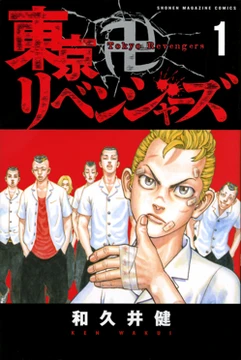
Toman (Post-Split Era)
A broken sun that refuses to set — Toman rebuilds from the ashes of its own fracture.

Toman (Tokyo Manji Gang) in its Post-Split Era refers to the reconstituted identity of Tokyo's most iconic biker gang after its most devastating internal fracture. What was once a tightly knit crew of riders bound by loyalty and shared purpose was shattered by leadership crisis, psychological deterioration at the top, and the pressures of rival coalitions. The post-split period is defined by the gang's painful attempt to reforge itself — to decide whether it can be more than the sum of its broken parts.
In the broader narrative, this era carries enormous emotional weight. It is the chapter where the characters must reckon with what they lost, who they still are, and whether the bonds that once held them together can survive the weight of everything that came before. For fans, it is the era of quiet rebuilding, of old loyalties tested against new wounds, and of a gang trying to remember why it existed in the first place.
- Full Name
- Tokyo Manji Gang (Toman)
- Leader
- Manjiro 'Mikey' Sano
- Vice Leader
- Ken 'Draken' Ryuguji
- Type
- Biker gang (motorcycle gang)
- Territory
- Tokyo, Japan
- Status
- Reconstituting (post-fracture)
- Protagonist Link
- Takemichi Hanagaki (time-travel connection)
Lore & Background
Toman's story is, at its core, a story about what a group of people becomes when the person at its center stops being able to hold the light. The gang was built on Mikey and Draken's shared vision: a crew of riders who looked out for each other on Tokyo's streets, who answered to no one above their own code. That foundation made them powerful, but it also made them fragile. When Mikey's psyche fractured under pressures the narrative reveals in layers — isolation, self-doubt, a sense of being a burden — the entire structure that depended on his steadiness began to crack.
The split was not a single dramatic event but a slow hemorrhage. Riders drifted. Alliances that had been forged in shared fights dissolved into suspicion. External enemies, sensing the gang's internal weakness, pressed their advantage. The Bonten coalition and other Tokyo biker organizations saw an opening in a Toman that was no longer the unified, terrifying force it had been. The post-split era is the period in which the survivors of that hemorrhage try to stop the bleeding, to look at each other across the wreckage and ask: do we still want to be this?
What makes this era resonate with readers is its refusal to offer a clean answer. The gang does not simply snap back into its old configuration. People have changed. Trust has to be rebuilt from scratch, and some bonds, once broken, heal with visible scars. The post-split Toman is messier, more uncertain, and in many ways more human than the polished, dominant force of its peak. It is a gang in recovery, still wearing the black jackets, still riding the same streets, but carrying a weight that the leather and the engine noise can't quite mask.
In Their Own Story
The rain had stopped an hour ago, but the asphalt still glistened under the sodium streetlights like something wet and alive. Mikey stood at the edge of the parking lot, his black jacket unzipped, the Manji cross on the chest catching the light in a way that made it look almost like a wound. He hadn't spoken in two days. Draken had tried, in his blunt, no-nonsense way, to fill the silence with talk about nothing — a new shop on the corner, a bike that needed a new chain. Mikey had listened. He hadn't answered.
Now, in the blue half-light of early morning, the others were arriving one by one. Chifuyu rolled up on his bike, engine ticking down to a low idle. Kaki leaned against a lamppost, arms crossed, jaw tight. Baji said something low and rough that might have been a greeting or might have been a challenge. No one moved to fight. No one moved to leave. They just stood in the wet parking lot, a small circle of black leather and quiet, and waited for the man at the center to decide whether he was still their sun.
Mikey turned. Looked at each of them. And for the first time in a long while, he almost smiled.
Reader's Guide
Toman was founded in the early 2000s as a small group of delinquent bikers on Tokyo's streets, co-led by Mikey and Draken. What began as a handful of riders grew into one of the city's most feared motorcycle gangs.
Key members in rank order: Mikey (President), Draken (Vice President), followed by division captains and core riders including Chifuyu, Kaki, Baji, and Mitsuya. Takemichi, the series' protagonist, became connected to the gang through his time-travel involvement in its history.
Territory and visual identity: Toman operates across Tokyo. Members wear black leather jackets bearing the Toman emblem, a stylized Manji cross. The gang's visual signature is the black-on-black uniform with the cross logo, paired with motorcycles that serve as both transport and a statement of presence.
Rise and peak: Toman grew from a scrappy local crew into a dominant force in Tokyo's biker scene, rivaling and surpassing larger organizations. Their peak came during a period of maximum territorial control and internal unity.
Fall and fracture: Internal conflict, Mikey's psychological deterioration, and external pressure from rival coalitions shattered the gang's unity. The split left Toman in disarray, with riders drifting and alliances dissolving.
Rivalries and alliances: Toman's primary antagonists include the Bonten coalition and various other Tokyo biker gangs. Alliances were formed and broken throughout the narrative, often reflecting the gang's internal state.
The post-split era represents Toman's attempt to heal, restructure, and reclaim its identity as a unified gang rather than a collection of fractured individuals. It is an era of quiet rebuilding, of old loyalties tested against new wounds.
Did You Know?
- Toman's name is a portmanteau of 'Tokyo' and 'Manji' (the Japanese character for the swastika-like cross, here used purely as a geometric emblem), giving the gang its distinctive cross logo.
- The protagonist Takemichi is not a traditional biker by background; his connection to Toman is forged through time travel, making his loyalty to the gang a choice made across multiple timelines rather than a simple stree
- Mikey and Draken's relationship as co-founders and the 'Sun and Moon' of the gang is the emotional spine of the entire series, and the post-split era is defined by the strain placed on that bond.
- The gang's black leather jackets and Manji cross emblem are consistent visual identifiers across all eras of the story, serving as a visual anchor even as the gang's internal dynamics shift dramatically.
More in Factions & Groups
Elsewhere in the Tokyo Revengers universe
Spotted an error? Know more?
This is a living reference — every entry is fact-audited, and reader corrections feed straight into our audit queue. Suggest an edit · See this site's audit record