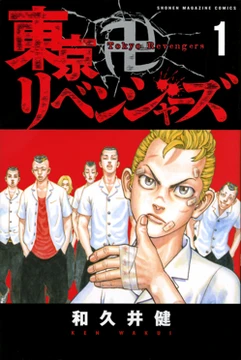
Tokyo Manji Gang
A family forged in fists, loyalty, and the unbreakable Manji on their backs.

The Tokyo Manji Gang, universally known as Toman, is the central delinquent organization of the Tokyo Revengers world. Born from the vision of its founder, Manjiro Sano, Toman carved out a territory in Tokyo's underbelly not through cold ambition but through a fiercely held belief that a gang should be a family—protecting its members and the neighborhood from the outside world's cruelties. Its symbol, the Manji (卍), became a badge of loyalty that every member wore with pride.
In the broader story, Toman is the lens through which the entire narrative is told. Its rise, its fractures, and its ultimate fate are inextricable from the time-traveling journey of its most unlikely member, Takemichi Hanagaki. Every alliance, every betrayal, and every scar in the series traces back to the choices this gang made in the halls of a Tokyo school and the alleys behind them.
- Full Name
- Tokyo Manji Gang (Toman)
- Founder
- Manjiro Sano (Manji)
- Symbol
- Manji (卍)
- Type
- Delinquent (yanki) gang
- Core Philosophy
- Family; the 'Good Yanki' code of protecting one's own
- Protagonist Member
- Takemichi Hanagaki
- Setting
- Tokyo, Japan (2000s–2010s era)
Lore & Background
Toman was never built on territory alone. Manjiro Sano gathered a ragtag group of outcast students and declared that their bond mattered more than any rival gang's intimidation. The Manji symbol—ancient, geometric, unmistakable—was stitched onto white shirts and school uniforms, turning a simple character into a promise: no one in this family gets left behind. That philosophy became the gang's spine, the reason members would throw themselves into a fight they could not win simply because a brother was on the ground.
As Toman grew, so did the weight of its ideals. Mikey, the gang's most magnetic and enigmatic leader, embodied both its highest aspirations and its deepest contradictions. His charisma could unite a hundred delinquents under one banner, yet the same intensity that made him a protector could, under pressure, fracture the very family he swore to defend. The tension between Mikey's light and his shadow runs through every arc of the story, and it is Takemichi—small, ordinary, stubborn—who keeps reaching back through time to remind everyone what Toman was supposed to be.
The gang's history is also a history of loss. Members fall, betrayals cut deeper than any blade, and the streets of Tokyo remember every body dropped on the pavement. Yet the Manji never truly disappears. It is passed down, re-stitched, re-worn. In the mythology of the series, Toman is less a criminal organization and more a living, bleeding organism that refuses to die because its members refuse to let it.
In Their Own Story
The fluorescent lights of the school hallway buzzed at 6 a.m., long before the first bell. Takemichi stood at the far end of the corridor, his white shirt still damp with the night's rain, the Manji stitched over his heart catching the pale light. Around him, the rest of Toman filled the space like a second family at a dinner table—Draken cracking his knuckles, Baji leaning against the lockers with that lazy half-smile, Chifuyu already sharpening his resolve into something sharp enough to cut. Somewhere down the hall, Mikey's shadow stretched long and thin, and for a moment the whole gang went quiet, the way you go quiet when the person you love most is about to say something that will change everything. Takemichi gripped his own fist. He had seen what came next. He had seen it in a timeline where the Manji meant nothing because the people wearing it were gone. Not this time. Not while he could still run back, still grab someone's collar, still say the words that mattered before the silence swallowed them whole. The bell rang. Toman moved as one.
Reader's Guide
It begins with Manjiro Sano, a young man who looked at the fractured gangs of Tokyo and decided the word 'family' was not just a slogan but a law. He gathered the lost, the angry, the ones no one else would claim, and he gave them a symbol—the Manji—and a promise: you protect your own, or you are not one of us. That single decision, made in a schoolyard with no audience, became the foundation everything else was built upon.
From that seed, Toman grew into the most recognizable name in Tokyo's delinquent scene. Mikey rose to the center, his presence so absolute that the gang's identity became inseparable from his. But a family built around one person is a family that can shatter when that person cracks. The fractures came slowly—a whispered doubt here, a broken promise there—until the day the Manji on a member's back meant something entirely different to the person wearing it than to the person watching.
And then there was Takemichi. Small. Unremarkable. The kind of kid who would be forgotten in a crowd. But he carried something none of the other members had: the ability to see the future he was trying to prevent. Every time he stumbled back through time, he was not just saving a life; he was trying to save the idea that Toman was. That the Manji still meant what Manji meant when he first stitched it onto a shirt. The past and the future bled into each other, and the gang's history became a loop Takemichi kept trying to break, because he knew—if he let go, the family dissolved, and the Manji was just a shape on fabric with no one left to honor it.
Did You Know?
- The Manji (卍) symbol is an ancient character with roots in East Asian and Buddhist iconography, chosen by the founder Manjiro Sano and named after him, giving the gang its identity.
- Takemichi's time-travel ability is the narrative engine of the entire series; his repeated journeys back into Toman's past are what allow the reader to witness the gang's history unfold and fracture.
- Toman's 'Good Yanki' philosophy—fighting fiercely while protecting the vulnerable and one's own members—sets it apart tonally from the more purely predatory rival gangs it faces.
- The gang's internal conflicts are as much emotional and psychological as they are physical; much of the series' tension comes from loyalty tested, trust broken, and the slow realization that the person you called brother
More in Lore & History
Elsewhere in the Tokyo Revengers universe
Spotted an error? Know more?
This is a living reference — every entry is fact-audited, and reader corrections feed straight into our audit queue. Suggest an edit · See this site's audit record