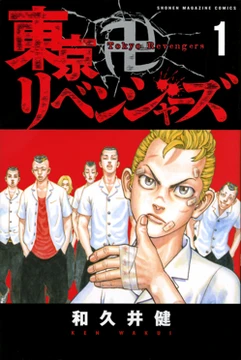
The Time-Leap
One clap, twelve years gone—every leap rewrites who survives and who doesn't.

The Time-Leap is the singular, world-breaking ability that drives the entire narrative of Tokyo Revengers. Belonging exclusively to Takemichi Hanagaki, it allows him to be flung backward roughly twelve years into his own past the moment he claps his hands together. Every leap he takes sends him into the high-school era of Tokyo, where the Tokyo Manji Gang (Toman) is still alive and its members are still breathing. What he does—or fails to do—during those borrowed years reshapes the future he returns to, making each cycle a high-stakes gamble with the lives of everyone he loves. As a fan-made concept, the Time-Leap is less a superpower and more a curse: it grants Takemichi infinite chances to fix a broken timeline, but it also traps him in a loop of guilt, memory, and consequence. The ability has no known origin, no second user, and no clean off-switch, which is precisely what makes the story's emotional weight so devastating for readers and viewers alike.
- Ability user
- Takemichi Hanagaki
- Trigger
- Clapping both hands together
- Time span (approx.)
- ≈ 12 years into the past
- Known users
- One (Takemichi only)
- Affiliation context
- Tokyo Manji Gang (Toman) era
- Narrative role
- Central plot device / recurring mechanic
- Status
- Ongoing throughout the series
Lore & Background
In the world of Tokyo Revengers, the Time-Leap operates on rules that are deliberately opaque. Takemichi discovers it under violent, humiliating circumstances: a stranger strikes him in the face, he reflexively claps his hands, and the neon-lit present dissolves into the fluorescent hum of a classroom he last saw at fourteen. There is no machine, no incantation, no visible portal—just the sound of two palms meeting and the world snapping backward like a rewound tape. The leap is not a visitation; it is a full-body, full-memory insertion into his younger self, complete with the adult knowledge of who will die, who will betray, and who will break. The most critical rule fans have pieced together across the arcs is that the future is not fixed. Every choice Takemichi makes in the past—whether he steps in to stop a fight, whether he speaks a name aloud, whether he simply stands in a different hallway—ripples forward and rewrites the timeline he snaps back into. This means a single careless word can cost a life, and a single act of kindness can save one. The Time-Leap thus functions as both a narrative engine and a moral instrument: it forces the reader to weigh every small decision against the catastrophic futures it can produce. What makes the ability uniquely tragic is its one-way emotional cost. Takemichi carries the memories of every version of the timeline he has seen, including versions where people he loves are dead, broken, or gone. He cannot share those memories with the people he is trying to save, because they only remember the timeline that currently exists. He is, in every sense, the sole custodian of every possible past, and the weight of that knowledge isolates him from the very gang he is trying to protect.
In Their Own Story
The fluorescent lights of Shonan High buzzed at a frequency Takemichi's adult ears still hadn't learned to ignore. He stood in the hallway between the second-year classrooms, his school uniform too stiff, his knuckles still stinging from the slap that had sent him here. Around him, the world was loud and alive in a way the 2020s version of Tokyo never was—laughter spilling from a classroom door, the distant rumble of engines on the road outside, a girl with a bob haircut arguing with her friend about a test score. None of them knew. None of them knew that in the version of the future he had just left, one of those engines would never start again. He pressed his palms together. The hallway shuddered. The fluorescent hum stretched into a long, thin whine, and the faces around him smeared like wet paint. When the world snapped back into focus, the ceiling was different—lower, older, the paint peeling at the edges. He was back. He checked his hands. They were trembling. He had exactly one more chance to say the right thing, in the right order, before the timeline sealed itself shut again. He exhaled, straightened his shoulders, and walked toward the classroom door. This time, he would not stand in the hallway. This time, he would be inside when it happened.
Reader's Guide
The Time-Leap is the narrative spine of Tokyo Revengers. Takemichi Hanagaki, a young man in his early twenties, discovers that clapping his hands together sends him roughly twelve years into his own past, into the high-school era where the Tokyo Manji Gang is still active and its members are still alive. The ability is exclusive to him—no one else in the story can replicate it, and no in-universe explanation is ever fully provided. Each leap is a full-body insertion: Takemichi inhabits his younger self, retains all adult memories, and can interact with the characters of that era as a peer. His actions in the past directly alter the future he returns to. A fight he prevents, a name he speaks, a person he pulls out of the way—all of it rewrites the timeline. This means the story is structured as a series of cause-and-effect loops, where each cycle reveals new information and new stakes. The emotional core of the mechanic is memory and isolation. Takemichi remembers every version of the timeline he has witnessed, including those where people he loves are dead or broken. The people he is trying to save only remember the timeline that currently exists, so he cannot warn them, cannot show them, cannot explain. He carries every possible grief alone. For fans, the Time-Leap is what transforms a delinquent-biker story into a time-loop tragedy. It turns every hallway, every rooftop, every late-night phone call into a potential turning point, and it makes Takemichi's smallness—his cowardice, his fear, his stubborn refusal to let go—feel enormous against the scale of the lives he is trying to protect.
Did You Know?
- The Time-Leap is the only ability of its kind in the entire Tokyo Revengers universe; no other character, ally, or antagonist is shown to possess or replicate it.
- Because Takemichi retains adult memories across every leap, he simultaneously remembers multiple contradictory versions of the same day—some where a character is alive, some where they are not—making his internal state a
- The leap is not a passive, dreamlike state: Takemichi's body is fully present in the past, he can be injured, he can speak, and his physical actions have tangible, irreversible consequences on that era's events.
- The ability has no known origin, no scientific explanation, and no in-universe 'off switch.' It simply activates when the trigger occurs, which means Takemichi cannot choose when or how many times he will be sent back.
More in Lore & History
Elsewhere in the Tokyo Revengers universe
Spotted an error? Know more?
This is a living reference — every entry is fact-audited, and reader corrections feed straight into our audit queue. Suggest an edit · See this site's audit record