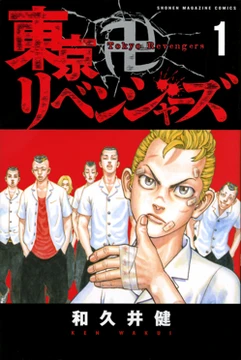
The Great War
Two gangs, one city, and a brotherhood that must choose between pride and survival.

In the sprawling gang-warfare saga of Tokyo Revengers, "The Great War" is the fan-coined umbrella term for the most epic and consequential conflict in the series: the all-out war between the Tokyo Manji Gang (Toman) and the rival organization Bonten (Tenjiku). It is the battle that tests every bond, every loyalty, and every hidden fracture within Toman, and it is the crucible in which Takemichi Hanagaki's time-leaps find their most desperate purpose.
This war is not merely a turf dispute. It is the story's emotional and thematic center—a collision of two philosophies of brotherhood, two visions of what a gang can be, played out across Tokyo's streets in a storm of fists, blades, and broken promises. Every character who matters is dragged into it, and the scars it leaves define the rest of the series.
- Conflict
- Toman (Tokyo Manji Gang) vs. Bonten (Tenjiku)
- Setting
- Tokyo, Japan — streets, alleys, and open lots
- Protagonist
- Takemichi Hanagaki (time-leaper)
- Key Factions
- Tokyo Manji Gang, Bonten
- Nature
- Full-scale gang war / ideological clash
- Narrative Role
- Central conflict driving the main plotline
Lore & Background
The Great War erupts from a long simmer of disrespect, territorial encroachment, and personal vendettas. Bonten, a disciplined and expansionist gang, pushes into Toman's home turf with a confidence that reads as a declaration of war. Toman, under the dual leadership of Mikey (Manjiro Sano) and Draken (Ryuguji Kazutora), responds not with a skirmish but with a full mobilization—every member, every ally, every grudge drawn into a single, grinding conflict.
What makes this war "great" in the eyes of fans is its scope and its cost. It is not a single night of fighting; it is a campaign that stretches across weeks of story time, punctuated by truces that dissolve, alliances that fracture, and revelations that rewrite who everyone thought they were fighting for. Takemichi's ability to leap backward through time turns the war into a recursive puzzle: he must prevent the battles that cause the war while simultaneously surviving the battles that the war demands.
The war also exposes the "Darkness" within Mikey—a shadow-self that craves dominance and isolation—and forces Draken, the loyal second, into the agonizing role of the one who must hold his best friend back from becoming the very thing Toman was built to oppose. The Great War is, at its core, a war about whether a brotherhood can survive the person at its center.
In Their Own Story
The rain had stopped, but the puddles still trembled. Takemichi stood in the middle of a back alley in Koenji, his knuckles split and crusted with old blood, and listened to the distant sound of boots on wet asphalt. Somewhere past the fire escape, a voice—Mikey's, or maybe the other Mikey, the one who didn't blink—called out a name he couldn't quite hear. He wiped his face with the back of his hand and tasted copper. The war wasn't a single explosion. It was a thousand small violations: a chair thrown, a collar grabbed, a brother turned away at a crossroads. He had lived this night three times now. Each time the ending was slightly different. Each time someone he loved was one step further from the edge. He straightened his spine, spat the blood into the gutter, and walked toward the sound of boots. There was no version of this war where he stayed still.
Reader's Guide
Before the war, there was the insult. Bonten crossed a line that Toman's members could not walk back, and the response was not a message but a mobilization. Mikey gave the order in a voice so quiet that only Draken and the inner circle heard it, and by the time the rest of the gang understood what was happening, the first engagements had already scarred three blocks of the neighborhood.
The war unfolded in waves. Early clashes were territorial—Bonten testing Toman's resolve, Toman answering with the kind of overwhelming, chaotic numbers that only a gang built on personal loyalty can field. But the true turning point came when the conflict stopped being about land and became about identity. Bonten's leaders began to frame the war as a judgment: Toman would either prove it was more than a collection of delinquents or it would be erased.
Takemichi's time-leaps turned the war into a palimpsest. He would fight a battle, lose someone, leap back, and try to save them—only to find that saving one person doomed another. Each loop tightened the noose of causality. The war that began as a street fight became a recursive tragedy, a story that could not be unwound without breaking the person trying to unwind it.
What the war set in motion still echoes. The alliances formed under fire became the architecture of every conflict that followed. The fractures in Toman's leadership never fully healed. And Mikey's Darkness, once unleashed in the heat of battle, became a permanent resident—a ghost that haunts every quiet moment after the fighting stops. The Great War did not end. It merely changed shape, and its consequences are the ground every subsequent character stands on.
Did You Know?
- Takemichi's time-leaps mean he experiences the same war multiple times, each loop altering alliances and outcomes in ways that compound across the series.
- The conflict is as much ideological as physical: Bonten and Toman represent contrasting philosophies of what a gang's purpose should be, making the war a clash of worldviews, not just territory.
- Mikey's "Darkness"—a shadow aspect of his personality—surfaces most violently during the war, forcing Draken into the role of restraining his own best friend.
- The war's aftermath reshapes the power dynamics of every subsequent conflict in the series, meaning characters in later arcs are still reacting to decisions made during this one.
More in Lore & History
Elsewhere in the Tokyo Revengers universe
Spotted an error? Know more?
This is a living reference — every entry is fact-audited, and reader corrections feed straight into our audit queue. Suggest an edit · See this site's audit record