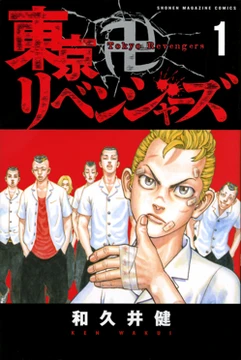
The Toman Crest (crescent moon & star emblem)
A crescent moon and a star, stitched in black and red: the only badge that never fades, no matter how many times the past is rewritten.

The Toman Crest is the emblem of the Tokyo Manji Gang, a crescent moon paired with a star rendered in clean, bold linework. It is stitched onto the black jackets and hoodies that every member wears, making it one of the most instantly recognizable symbols in the world of Tokyo Revengers. It is not a magical object or a weapon; its 'power' is entirely psychological and social. The crest is a promise of belonging, a visual shorthand that says *you are part of this family, and this family will not let you fall.*
From the moment Takemichi first stumbles into Toman's orbit, the crescent-and-star mark becomes the axis around which loyalty, rivalry, grief, and redemption all orbit. It appears on jackets, on walls, on the minds of everyone who has ever worn one. In a story where time can be rewound and futures can be rewritten, the crest is the one constant that never changes — a fixed point of identity in a world of shifting timelines.
- Type
- Gang emblem / symbolic artifact
- Affiliation
- Tokyo Manji Gang (Toman)
- Origin
- Established by Manjiro Sano, the gang's founder
- Worn by
- All recognized members of Toman on their jackets and hoodies
- First appears
- Early in the manga and anime series, when Takemichi first encounters the gang
- Status
- Active symbol; persists across timelines and gang restructurings
Lore & Background
The Toman Crest was born from Manjiro Sano's vision of a gang that was, above all, a family. In a Tokyo underworld where loyalty is currency and betrayal is the default, Manji wanted a mark that said something different. The crescent moon evokes the idea of a light that is not yet full — potential, growth, the promise of a brighter phase still to come. The star that anchors it is the fixed point, the north star of the group's identity: no matter how chaotic the streets get, you always know where home is. Together they form a compact, almost sacred geometry that members can spot from across a crowded Shibuya crossing.
In the narrative, the crest carries enormous emotional weight. When a member is expelled, wounded, or killed, the jacket bearing that mark becomes a relic. Characters are shown clutching a torn sleeve, staring at the embroidered moon, or deliberately ripping the crest off in a moment of broken trust. The symbol is so loaded with meaning that its presence or absence on a character's back can tell the audience more about their emotional state than a page of dialogue could. It is the visual language of Toman's internal politics: who is in, who is out, who has earned the right to carry that star.
Across the many timelines Takemichi traverses, the crest remains the one element that does not shift. Characters age, alliances fracture, the gang splinters and reforms, but the crescent and star endure. This makes it a quiet anchor in an otherwise unstable narrative — a reminder that even when the future is malleable, the identity a person chose to carry is not. It is, in the most practical sense, the 'artifact' of Tokyo Revengers: not something that grants power, but something that demands you live up to the power others have placed in you.
In Their Own Story
The rain had not stopped for three days. Takemichi stood under the awning of a shuttered convenience store in Shinjuku, watching the neon bleed into the puddles. Across the street, a group of Toman members huddled under a shared umbrella, their black jackets glistening, the crescent moon and star on their backs catching the amber glow of a streetlight. One of them — a kid no older than fifteen — kept tugging at the hem of his jacket, trying to hide the crest. The older member beside him just laughed, grabbed the boy's collar, and pulled the emblem back into the light.
"You think you can hide who you are?" he said, not unkindly. "The moon doesn't hide from the rain."
The boy's shoulders dropped. He let the star show. And for a moment, in that small cluster of wet black jackets, the whole broken city felt a little less like a place where you had to fight alone.
Reader's Guide
The Toman Crest is a symbolic emblem, not a supernatural artifact. It grants no physical power, accelerates no healing, and opens no doors in the literal sense. Its function is entirely social and psychological: it marks membership, signals allegiance, and binds the wearer to a collective identity.
Who wears it: Any individual recognized as a member of the Tokyo Manji Gang. In practice this means the crest appears on the back and sometimes the chest of the gang's signature black jacket or hoodie. Wearing it is an act of commitment; removing it, or having it removed, is an act of expulsion or self-exile.
Hard rules: (1) The crest does not transfer power — a person who puts on a Toman jacket does not suddenly gain the fighting skill or charisma of the person who wore it before. (2) The crest carries social weight: wearing it in front of rival gangs (Bonten, Moebius, etc.) is a declaration of affiliation and can provoke conflict. (3) The emotional cost is real. Characters who lose their place in the gang — through injury, betrayal, or death — are shown to grieve the mark as much as they grieve the people. The crest becomes a reminder of what was promised and what was lost.
Concrete examples: Takemichi's initial shock at seeing the crest on a stranger's back and feeling an inexplicable pull toward it. The moment a member's jacket is torn off in a fight, leaving the star exposed and vulnerable. The quiet scene of a character folding a damaged jacket and keeping it, the crescent moon still visible in the dim light of a room where no one else is watching.
Did You Know?
- The crescent moon in the crest is often read by fans as a symbol of potential and growth — a light that is not yet full, mirroring the 'underdog' ethos of Toman's members, many of whom are young, struggling, or running f
- In the manga and anime, the crest's visual design is deliberately simple and bold so it reads clearly even at a distance, on a moving jacket, or in a chaotic fight scene. This is a practical storytelling choice: the audi
- The emotional weight of the crest is a recurring motif: characters are shown touching, hiding, or removing the emblem in moments of vulnerability, making it function almost as a second character in scenes about loyalty a
- Because the story involves time travel and multiple timelines, the crest is one of the few visual elements that remains consistent across every version of events, serving as a narrative anchor for the audience navigating
More in Powers & Artifacts
Elsewhere in the Tokyo Revengers universe
Spotted an error? Know more?
This is a living reference — every entry is fact-audited, and reader corrections feed straight into our audit queue. Suggest an edit · See this site's audit record