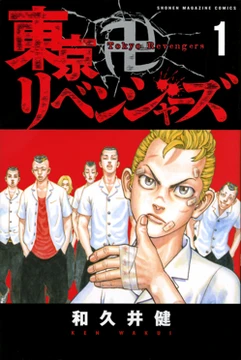
The King and the Devil
One man, two crowns: the light that builds a kingdom and the dark that burns it to ash.

"The King and the Devil" is the central duality that defines Manjiro Sano (Mikey) across the Tokyo Revengers saga. On one hand, the King is the radiant, almost mythic leader of the Tokyo Manji Gang—charismatic, protective, and the gravitational center around which every delinquent in Tokyo orbits. On the other, the Devil is the shadow-self that emerges when the world Mikey built crumbles: a figure of cold, surgical violence who dismantles everything he once protected. This split is not a subplot; it is the engine of the entire narrative, driving Takemichi's repeated time-leaps and the fates of every gang member caught between those two faces. The concept also extends beyond Mikey into the broader delinquent hierarchy, where rival organizations (notably the Bonten) position themselves as the Devil to Toman's King, forcing a collision of ideologies that reshapes the Tokyo underworld. Whether read as a character study or a gang-political arc, the King-and-Devil axis is the story's spine.
- Central figure
- Manjiro Sano (Mikey)
- Affiliation
- Tokyo Manji Gang (Toman)
- Role
- Supreme leader / 'King' of Toman; the 'Devil' persona as his darker alter
- Thematic function
- Core duality driving the multi-timeline narrative
- Rival faction involved
- Bonten gang
- Narrative scope
- Spans the manga's mid-to-late arcs, culminating in the final confrontation
Lore & Background
In the world of Tokyo Revengers, the delinquent hierarchy is governed by an almost feudal logic. The King is not merely a captain; he is the sun around which every orbit is calculated. Mikey embodies this to an almost supernatural degree. His smile, his casual authority, his willingness to shield his underlings from the worst consequences—these are the tools of the King. Toman's members do not simply follow him; they believe in him the way a village believes in its lord. When the King is present, the gang is a family. When he is absent or broken, the structure fractures. The Devil, by contrast, is what surfaces when that belief is shattered. It is not a separate person or a possessed state in the supernatural sense; it is Mikey stripped of the social contract that held him together. Without the people who needed him, without the purpose of protecting them, the violence he has always carried has no container. The Devil does not rage—it calculates. It removes obstacles with the same indifference a surgeon removes a tumor. This is what makes the duality so terrifying to the characters around him: the King and the Devil are the same hands, the same eyes, separated only by whether someone still needs saving. The Bonten gang enters this equation as an external mirror. Where Toman's identity is built around the King's protective mythos, the Bonten operates on a philosophy closer to the Devil's logic—survival, dominance, the rejection of sentimental loyalty. Their clash is not merely a turf war; it is a philosophical collision between two answers to the question 'what holds a group of young men together?' The outcome of that collision, and whether Mikey can reintegrate his two halves, is the stakes that hang over every chapter of the late story.
In Their Own Story
The rain had not stopped for three days. Mikey stood at the edge of the overpass, collar up, cigarette unlit between his fingers because the wind kept snuffing it. Below, the street was a river of neon and exhaust, the usual Tokyo noise muffled into a hum. He could see the Bonten members two blocks south, their white uniforms cutting through the grey like a wound. He did not move. He had not moved in a long time. A voice behind him—Ryugu, maybe, or one of the younger Toman kids who still called him 'bro.' They said something about the meeting, about what he was going to say. He let them talk. The King in him wanted to turn around, to put his hand on the kid's shoulder, to say *it's fine, we'll figure it out.* The Devil in him simply watched the rain hit the asphalt and counted the seconds until the sound of their footsteps changed. He exhaled. The cigarette was still dry. He put it back in his pocket and walked south, and the two halves of him walked together for the first time in a very long while.
Reader's Guide
The King-and-Devil arc unfolds across the mid-to-late chapters of the manga. Mikey, long established as Toman's unshakable leader, begins to show cracks after a series of betrayals and losses that strip away the people who anchored his 'King' identity. His behavior shifts: the warmth drains out, replaced by a cold, strategic ruthlessness that even his closest friends cannot predict. The Bonten gang escalates its pressure, forcing Toman into a corner where the old rules of loyalty no longer protect anyone. Takemichi, through his time-leap ability, repeatedly attempts to intervene, but each attempt reveals that the Devil is not a temporary possession—it is a structural part of Mikey that was always there, kept dormant by purpose and love. The climax forces a confrontation not between two gangs in the traditional sense, but between Mikey's two selves, with the rest of Toman and the Bonten caught as collateral. The resolution does not simply 'fix' Mikey. Instead, the story reframes the duality: the King and the Devil are not enemies to be separated but two truths that must coexist. The impact ripples outward—Toman's identity is rebuilt on a less idealized foundation, rival gangs reassess their loyalties, and Takemichi's role shifts from time-traveling savior to someone who must accept that some wounds do not heal by rewinding the clock. The arc cements the series' central argument: that love and violence are not opposites but partners, and that a leader who denies one will be consumed by the other.
Did You Know?
- Mikey's 'King' and 'Devil' are never presented as separate characters or a supernatural split; the manga treats them as two behavioral modes of the same person, making the duality a psychological rather than mystical con
- The Bonten gang's philosophy is deliberately constructed as a mirror to Toman's, turning their conflict into a thematic debate about loyalty versus survival rather than a simple good-versus-evil turf war.
- Takemichi's time-leap mechanic becomes almost useless during the height of the King-and-Devil arc, because the problem is not a single event that can be undone but a fundamental fracture in a person's identity.
- Mikey's 'Devil' mode is characterized in the story by a notable absence of emotion—no shouting, no rage—making it far more unsettling to the characters around him than any display of outward anger.
More in Story & Timeline
Elsewhere in the Tokyo Revengers universe
Spotted an error? Know more?
This is a living reference — every entry is fact-audited, and reader corrections feed straight into our audit queue. Suggest an edit · See this site's audit record