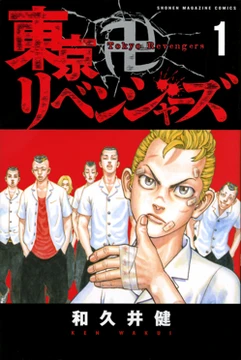
1998 Toman Founding
Five boys, one broken city, and the promise that no one would be alone anymore.

The 1998 Toman Founding is the origin event of the Tokyo Manji Gang, the central biker gang of the Tokyo Revengers universe. It marks the moment when a small band of teenage outcasts—led by the charismatic Manjiro 'Mikey' Sano and his closest friend Ryuji 'Draken' Hanma—decided to build something together out of nothing. What began as a handful of boys looking for a place to belong would grow into one of Tokyo's most feared and respected gangs, shaping every conflict, alliance, and betrayal the series explores.
In the story's structure, the founding is revealed as a foundational myth: the 'why' behind Toman's culture of brotherhood, its fierce loyalty, and the gravitational pull Mikey exerts over everyone who enters his orbit. Understanding 1998 is essential to understanding why the characters in 2010 fight the way they do, love the way they do, and ultimately tear themselves apart the way they do.
- Founder / First President
- Manjiro 'Mikey' Sano
- Co-Founder
- Ryuji 'Draken' Hanma
- Year of Founding
- 1998
- Affiliation
- Tokyo Manji Gang (Toman)
- Founding Members' Age
- Teenagers (approximately 15)
- Starting Size
- A small group of close friends
- Significance
- Origin of Toman's brotherhood culture and gang identity
Lore & Background
The founding of Toman is not a single dramatic event in the way a battle or a coronation might be. It is quieter than that, and more fragile. In 1998, a cluster of teenagers—kids from the margins of Tokyo, kids who had been pushed out of schools, out of homes, out of the neat little boxes society expects them to fit into—found each other. Mikey, with his golden eyes and an almost unsettling calm, had a vision: not just a gang, but a family. A place where the broken could stand together and call it strength. Draken, his fiercest and most protective friend, was the one who made sure the vision didn't dissolve into fantasy. He was the anchor, the one who said 'we do this together' when the world told them they were nothing.
The early days were scrappy and small. No territory wars, no hierarchy of Vice Presidents and Enforcers. Just a handful of boys who shared meals, shared bikes, shared the unspoken rule that what happened inside the group stayed inside the group. The name 'Tokyo Manji' was born from Mikey's own name, Manjiro, a deliberate branding of the group around his identity and his promise. It was less a corporate title and more a vow: this is mine, and you are in it, and I will not let you fall.
This founding myth is the bedrock of everything that follows. Every code of loyalty, every 'we protect our own' instinct, every time a Toman member throws himself in front of a blade for a brother—it traces back to that 1998 promise. And it is also the source of the gang's deepest vulnerability: because the structure was built on a single boy's charisma and a single friendship, when those things fracture, the entire edifice trembles. The series' central tragedy is, in many ways, the slow unraveling of what was built in that first, fragile year.
In Their Own Story
The summer heat in '98 made the asphalt shimmer like water. Mikey sat on the curb outside a shuttered konbini, legs crossed, golden eyes tracking a moth that kept battering itself against the dead fluorescent tube in the window. He didn't blink. He never blinked when he was thinking.
Draken dropped a dented can of black coffee at his feet. 'You're scaring the bugs.'
Mikey smiled. It was the kind of smile that made you want to follow him off a cliff. 'I'm thinking about a name.'
'You got a name.'
'Not a name for all of us. A name for what we're going to be.' He tilted his head, watching the moth give up and drift into the dark. 'Something that says we're not done yet. Something that says we're still here, and we're not alone.'
Behind them, the others were already there. You didn't have to look to know. You could hear the chain of a bike being kicked over, the scrape of a boot on concrete, the low murmur of someone laughing at nothing. They were fifteen. They were hungry. They were, in every measurable way, nothing.
Mikey picked up the coffee, took a sip, and said the name. Just once. Quietly. Like a secret he was letting the air keep.
And the air kept it. And they did too. And that was enough. That was always enough, for a while.
Reader's Guide
In the summer of 1998, on the fringes of a Tokyo that had no use for them, a group of teenagers who had been cast out of every institution that was supposed to hold them together made a quiet, irrevocable decision: they would hold each other. Manjiro Sano, who would become known only as Mikey, and Ryuji Hanma, the boy the world would call Draken, stood at the center of that decision. They were fifteen. They had no territory, no roster, no reputation. They had a name—Tokyo Manji, drawn from Mikey's own given name—and a rule: what is ours, we protect. What is broken, we mend. What falls, we catch.
This was not a founding in the way a corporation is founded. There was no charter, no meeting, no vote. It was closer to a fever breaking. One night became the next, and the next, and the group that had been two boys sharing a bench became five, then eight, then a constellation of kids who had nowhere else to go. The motorcycles came later. The colors came later. The fear that other gangs would learn to feel came much, much later.
What the founding set in motion was a gravitational field. Mikey's presence became the axis around which Toman's entire identity orbited. His calm was the gang's calm. His vision was the gang's direction. And Draken's role—always the second, always the shield, always the one who said 'stop' when the world said 'go'—became the check that kept the axis from spinning into chaos. Together, they built a culture of brotherhood so total, so all-consuming, that it would outlast every war, every betrayal, and every blood feud the gang would survive.
And that is the echo that rings through 2010. Every time a Toman member steps in front of a blade, every time the code of 'we do not abandon our own' is invoked, every time the name 'Tokyo Manji' is whispered with reverence or with grief—it is the 1998 promise speaking through them. The founding is not a chapter. It is the root. And roots, once broken, do not heal. They split. And the whole tree leans.
Did You Know?
- The 'Manji' in Tokyo Manji Gang is drawn directly from Mikey's given name, Manjiro, making the gang's identity literally inseparable from its founder's identity.
- The founding members were all approximately the same age—teenagers around fifteen—meaning Toman's culture of equality and brotherhood was forged among peers, not between a leader and subordinates.
- The founding predates the main 2010 timeline by roughly twelve years, meaning the 'present-day' Toman members are the product of a culture built when their leaders were still children by any adult standard.
- The gang's defining principle—protecting its own above all else, treating members as family rather than soldiers—originates in the 1998 founding ethos and is the single most cited code in the series.
More in Lore & History
Elsewhere in the Tokyo Revengers universe
Spotted an error? Know more?
This is a living reference — every entry is fact-audited, and reader corrections feed straight into our audit queue. Suggest an edit · See this site's audit record