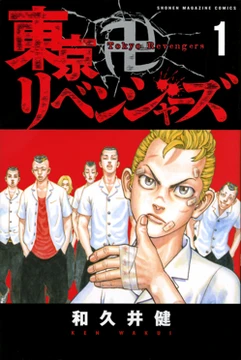
Mikey's Descent into Darkness
The boy who built a kingdom of smiles slowly forgets how to be a person.

Mikey's Descent into Darkness is the emotional and psychological spine of Tokyo Revengers' later narrative, tracking the slow unraveling of Manjiro Sano—the charismatic, almost mythic top of the Tokyo Manji Gang—into a fractured, violent figure who can no longer recognize the people he loves. What began as flashes of uncontrolled rage and a fearful isolationism gradually calcifies into a full identity crisis, culminating in the final arcs where the boy who once dreamed of a better world for his gang becomes the very thing his friends must fight to save. The descent functions as the series' central tragedy: it reframes every earlier victory and every act of loyalty as a countdown. Fans who fell in love with Mikey's sun-drenched grin and his easy, generous leadership watch that light gutter out scene by scene, making the later confrontations land with a grief that no amount of action choreography can soften.
- character
- Manjiro Sano (Mikey)
- role
- Top Leader of Toman; Final Arc participant
- affiliation
- Tokyo Manji Gang (Toman)
- first_appears
- Chapter 1 / Episode 1
- closest_bond
- Ken Ryuguji (Draken)
- status
- Alive (as of the published series)
Lore & Background
Mikey's darkness is not a sudden corruption but a slow erosion. From the earliest chapters he carries a visible fracture: a childhood trauma shared with Kazutora Hanemiya that left both of them scarred and Mikey perpetually afraid that his own violence would hurt the people he loves. He copes by over-giving—protecting, leading, smiling—so that no one ever has to see the part of him that wants to disappear. Draken is the one person who can reach that part, which is why their bond is the emotional anchor of the entire gang and why its strain in later arcs feels so catastrophic. As the story progresses, the coping mechanism fails. Stress, loss, and the weight of leading Toman through escalating conflicts chip away at the wall Mikey built. His "dark side"—a state of dissociative, extreme violence—stops being a brief flicker and starts occupying more of his waking hours. He begins to distrust the very people who came to protect him, interpreting their concern as a threat. By the time the final arcs begin, the Mikey who once handed out candy to delinquents and laughed in the rain is barely recognizable, a hollow shell driven by a survival instinct that no longer distinguishes friend from foe. What makes the descent resonate with readers is its refusal to villainize him. Mikey never chooses malice; he is a trauma response made flesh, a kid who was never taught how to be hurt without breaking. The series treats his collapse with the same tenderness it gave his rise, asking the audience to grieve the person he was even as they watch the person he's becoming.
In Their Own Story
The rain hadn't stopped for three days. Mikey stood at the edge of the arena, barefoot, the concrete slick under his soles. He could hear them—Baji, Draken, the whole ragged line of Toman pushing through the gate with that stupid, stubborn hope in their eyes. He wanted to smile. He really did. The muscle in his cheek twitched, the way it used to, the way it did when he was twelve and Baji was throwing a rock at a pigeon and yelling about how the bird was a coward. But the smile didn't finish forming. Something behind his sternum locked, and the world went grey and quiet, and the boy in the grey was already reaching for a fist, already calculating the angle of Baji's jaw, already deciding that the man running toward him with open arms was just another thing that wanted to take what little was left. "Mikey," Baji called out, and his voice cracked on the name, and Mikey flinched like it was a blade. The rain kept falling. Neither of them moved. And somewhere under the grey, under the quiet, under the fist that wouldn't unclench, a twelve-year-old boy was still waiting for someone to tell him it was okay to be scared.
Reader's Guide
The descent unfolds across the middle and late arcs of the manga. In the earlier Toman conflicts, Mikey's instability is hinted at through brief, jarring outbursts of violence and a tendency to push his friends away when he feels overwhelmed. Baji consistently anchors him, and the gang's loyalty holds the structure together. The strain becomes visible when losses mount and the pressure on Toman's leadership intensifies; Mikey starts sleeping less, speaking less, and his dark-side episodes grow longer and more destructive. The Culling Game arc is the breaking point. Mikey enters the tournament and his dissociative violence escalates to a level that horrifies even his allies. He begins to perceive his friends' rescue attempts as attacks, and his combat style shifts from the fluid, protective fighting fans know to something brutal, self-destructive, and directionless. The arc's emotional climax centers on Baji and the core Toman members confronting Mikey not as an enemy to be defeated but as a friend to be reached, forcing him to choose between the isolated, armored version of himself and the vulnerable kid who once shared a bench with Baji under a streetlight. The impact radiates outward: Toman's identity, which was built around Mikey's generosity, must be redefined without him at the center. The arc recontextualizes every earlier fight—each was Mikey holding the line so the darkness wouldn't out, and the cost of that holding is what the Culling Game finally forces everyone to see.
Did You Know?
- Mikey's signature easy smile and generous, almost childlike demeanor are established in the very first chapter, making his later emotional withdrawal hit with particular force for readers who have followed him since epis
- His childhood trauma is shared with Kazutora Hanemiya, meaning the "darkness" is not a solo affliction but a wound two people carry in opposite directions, a detail the series revisits in the final arcs.
- Draken's role as Mikey's emotional anchor is woven into nearly every major arc; when their dynamic is tested, the narrative treats it as the series' most devastating turning point.
More in Story & Timeline
Elsewhere in the Tokyo Revengers universe
Spotted an error? Know more?
This is a living reference — every entry is fact-audited, and reader corrections feed straight into our audit queue. Suggest an edit · See this site's audit record