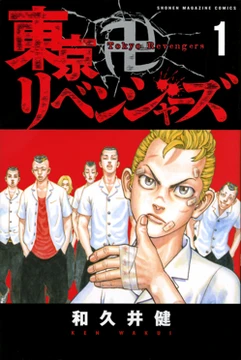
Bonten Arc
The past is not a place you visit—it is a wound that never fully closes.

The Bonten Arc is a major storyline in Tokyo Revengers that sends Takemichi Hanagaki far back into the past, to the era in which the Bonten yakuza syndicate was still being forged. Unlike earlier arcs that dealt with delinquent gangs in the 2010s, this arc plunges the story into the world of organized crime's roots, revealing how the choices of a handful of young men in the 1990s shaped the power structures that loom over every character in the present day.
It serves as a crucial origin story, connecting the 'Cursed' timeline to decisions made decades before Takemichi's own era. The arc forces him to confront the fact that some wounds and losses are not the result of a single bad day, but of a long chain of choices stretching back generations. It is one of the most emotionally heavy and lore-dense stretches of the manga, recontextualizing characters the reader has come to know by showing them as young, uncertain figures making irreversible decisions.
- Organization featured
- Bonten (yakuza syndicate)
- Era depicted
- 1990s (formative years of Bonten)
- Protagonist
- Takemichi Hanagaki
- Connected timeline
- 'Cursed' timeline
- Arc type
- Time-travel / origin story
- Story position
- Later arc in the manga's main sequence
Lore & Background
Bonten occupies a tier of power in the Tokyo Revengers world that sits above street-level delinquent gangs like Toman or Tenjiku. Where those groups fight for territory, pride, and a brotherhood defined by youth, Bonten operates as a structured yakuza organization with decades of accumulated influence, money, and violence. The Bonten Arc peels back the curtain on how that power was built, showing readers that the syndicate's founders were once young men making choices in smoky back rooms and on rain-slicked streets, long before the world Takemichi knows existed.
The arc is inseparable from the 'Cursed' timeline, which has been a recurring thread through the story. By the time Takemichi arrives in the 1990s, he is not simply observing history; he is walking through the exact moment where the timeline fractured. The decisions the Bonten founders make—who they ally with, who they betray, which debts they honor and which they bury—ripple forward and become the fixed points that no amount of time-travel can easily undo. This is what makes the arc so devastating: Takemichi realizes that some of the losses he has been trying to prevent were not accidents but consequences, planted in soil he is now standing in.
The emotional core of the Bonten Arc lies in its treatment of legacy. Characters the reader has known as hardened adults or as ghosts are here as teenagers and young adults, full of ambition and fear. Their choices are not made with the weight of decades behind them, and Takemichi's presence as a witness from the future adds a terrible gravity to every conversation. The arc asks whether knowing the outcome makes a choice any more or less tragic, and whether the people who built a world of power ever truly understood what they were building.
In Their Own Story
The rain in the 1990s hit different. It came down in sheets that turned the narrow alley behind the Bonten compound into a brown river, and the neon sign above the entrance buzzed and flickered, painting the wet concrete in sickly pink. Takemichi stood at the mouth of the alley, his school uniform soaked through, watching a group of young men in cheap suits argue over a table of cold noodles and cheap whiskey. One of them—barely older than Takemichi himself—slammed a fist on the table and said something about loyalty, about not letting the old guard bury them. The others laughed, but their eyes were hard. Takemichi recognized the jawline. He had seen it in a photograph, in a memorial, in the face of a man who would one day be called a kingpin. Right now, though, he was just a kid trying to be a man, and the rain was making everything blur. Takemichi pressed his hand against the wet wall and breathed, because in another minute he would have to decide whether to step forward or let the past keep its shape.
Reader's Guide
The Bonten Arc is triggered when Takemichi is sent back to the early 1990s, a period far earlier than any of his previous time jumps. He lands in a world where the Bonten yakuza is still in its formative years, and the streets are shaped by rival gangs and shifting alliances. The central conflict revolves around the founding ideals of Bonten and the choices its young members make that will echo through decades.
Takemichi witnesses the events that set Bonten on its path, encountering characters who are predecessors or ancestors of figures he already knows. The arc is deeply tied to the 'Cursed' timeline: the decisions made in this era ripple forward, altering who lives and who dies in the present. Several characters who were lost in earlier arcs are shown here in their youth, and the arc forces Takemichi to confront the cost of trying to change a past that has already calcified into the present.
The divergence from the 'main' timeline is significant: the Bonten Arc reveals that the 'Cursed' timeline is not a single mistake but a chain of choices stretching back decades. The cost of Takemichi's intervention is that he must accept certain losses as fixed, while the seeds of Bonten's power are planted in ways that will shape every subsequent arc. The arc closes with Takemichi returning to the present carrying new knowledge—and new grief.
Did You Know?
- Bonten operates at a level of organized power well above the delinquent gangs like Toman and Tenjiku, functioning as a structured yakuza syndicate with generational reach.
- The Bonten Arc is set in a time period significantly earlier than most of the story's other arcs, pushing Takemichi's time-travel to one of its furthest points.
- The arc is thematically and narratively linked to the 'Cursed' timeline, suggesting that the fractures in that timeline were seeded decades before Takemichi's own era began.
- Characters who appear as young, uncertain founders in the Bonten Arc are connected to figures the reader already knows in later arcs, creating a legacy thread that runs through the entire story.
More in Story & Timeline
Elsewhere in the Tokyo Revengers universe
Spotted an error? Know more?
This is a living reference — every entry is fact-audited, and reader corrections feed straight into our audit queue. Suggest an edit · See this site's audit record