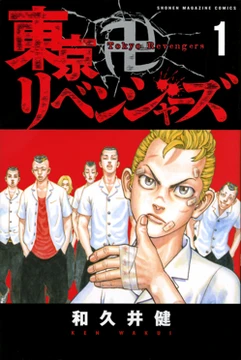
The Hinata Rescue
One boy, one name, and every timeline he can reach to keep her alive.

The Hinata Rescue is the emotional spine of Tokyo Revengers, the sprawling time-travel gang saga by Ken Wakui and Gosho. It is the arc in which Takemichi Hanagaki, driven by the grief of his girlfriend Hinata Tetta's death in the main timeline, repeatedly throws himself back through time to reach the moment before she is killed and rewrite that outcome. Every jump, every alliance forged with the Tokyo Manji (Toman) gang, and every blood-soaked alley fight ultimately orbits this single, desperate mission: get Hinata home alive.
Within the broader narrative, the Hinata Rescue functions as both the inciting wound and the moral compass. It is what pulls Takemichi from a passive, self-loathing adult into the thick of 2000s Tokyo delinquency, and it is the thread that ties together the Toman's rise, its internal fractures, and the cascading consequences of every timeline he alters. Fans regard it as the story's beating heart because every other conflict—rival gangs, betrayals, the Toman's legacy—ultimately serves or threatens the question of whether Hinata will see another sunrise.
- Subject
- Hinata Tetta
- Role
- Takemichi's girlfriend; the person whose survival drives the rescue arc
- Affiliation
- Associated with the Tokyo Manji (Toman) gang
- Status in main timeline
- Killed
- Status in rescue timeline
- Survives (altered fate)
- Arc function
- Central emotional objective of the time-travel narrative
Lore & Background
Hinata Tetta is the anchor of Takemichi's entire existence. In the main timeline, her death shatters him so completely that the very act of witnessing it becomes the catalyst for his time-travel ability to fire. He does not merely want to change the past; he needs to, because without her the present is a hollow shell. The rescue arc strips away the spectacle of gang warfare and reveals the raw, personal stakes beneath: a man who has lost everything else will burn through years of his own life to walk her back to a kitchen where the rice is still warm.
The Toman gang is inextricable from Hinata's fate. Her connection to the crew means that the violence that claims her is not a random accident but a consequence of the gang's wars, rivalries, and internal politics. Saving her therefore cannot be done in isolation; Takemichi must navigate the Toman's hierarchy, earn the trust of its members, and sometimes stand against the very people she cares about. This makes the rescue arc a story about loyalty in two directions at once—loyalty to Hinata and loyalty to the people who love her.
What makes the arc resonate with readers is its emotional honesty. Takemichi is not a natural fighter, not a born leader, and not even a confident young man. He is a scared, clumsy, deeply ordinary person who keeps choosing the hardest path because the alternative is a world without her. The gang world provides the setting and the stakes, but the engine of the story is something far smaller and more universal: refusing to accept a loss that should not have happened.
In Their Own Story
The rain had not stopped for three days. Takemichi stood at the edge of the underpass, his school bag soaked through, watching the neon of the shop signs bleed pink and blue into the puddles. Somewhere past the second intersection, past the shuttered pachinko parlor and the convenience store where the old man always waved, she was alive. In this timeline, she was still alive. He could feel it in the weight of the air, in the way the night hummed with the bass of a radio playing from a truck parked by the canal. He had not yet heard the sound that would end everything. He had not yet seen the face he would never forget. He stepped off the curb, into the wet street, and walked toward her. Not because he was brave. Because he could not stand still while the world was still, impossibly, on the side of her breathing.
Reader's Guide
Trigger: Hinata's death in the main timeline. The moment Takemichi witnesses or learns of her killing, his ability to be sent back in time activates, hurling him to a period before the fatal event.
Time period: Takemichi lands in the era of the Toman gang's active conflicts, a window before the specific violence that claims Hinata. He is thrust back into the social orbit of the crew—its members, its rivalries, its unspoken codes.
Central conflict: Takemichi must identify the chain of events leading to Hinata's death and sever it. This means confronting the Toman's internal tensions, rival gang pressure, and the specific individuals whose actions converge on her. He cannot simply hide her; the world keeps pulling her back into the crossfire.
Outcome: In the altered timeline, Hinata survives the event that killed her in the main line. However, the change carries a cost—other characters who died in the main timeline may still fall, and the Toman's trajectory shifts. Alliances that existed in the original line may not form, and the gang's future is rewritten around a different set of losses.
Divergence: The rescued timeline diverges sharply from the main line the moment Hinata's fate changes. The Toman's leadership, its wars, and its members' personal arcs all ripple outward. The cost is not a single price but a redistribution of grief: the people who were supposed to lose her in the main timeline now face different wounds, and Takemichi must carry the knowledge of what could have been.
Characters at stake: Hinata (survives in this line), the Toman members who were present or involved in the main-timeline killing (their fates shift), and Takemichi himself, who bears the memory of every timeline he has seen collapse.
Did You Know?
- Hinata's death is not a single incident but the culmination of a chain of gang conflicts, meaning saving her requires Takemichi to untangle multiple rivalries simultaneously rather than simply dodge one attack.
- Takemichi's time-travel ability is not a reliable tool; each jump carries the risk of altering events in ways that create new threats to Hinata, turning the rescue into a series of escalating gambles rather than a single
- The Toman gang's identity is deeply tied to the members who are present or absent in each timeline, so saving Hinata can inadvertently change who leads the crew and what the gang becomes.
- The emotional core of the arc is that Takemichi is not trying to become a hero or a gang leader—he is trying to be the person who was there when it mattered, and the story treats that small, human need as the most powerf
More in Story & Timeline
Elsewhere in the Tokyo Revengers universe
Spotted an error? Know more?
This is a living reference — every entry is fact-audited, and reader corrections feed straight into our audit queue. Suggest an edit · See this site's audit record