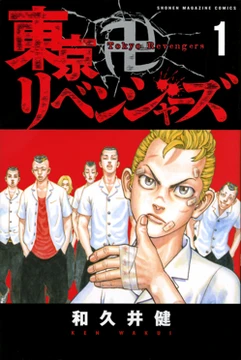
The Tetsuwa Divergence
Two gangs, one city, and a boy who keeps losing the fight before it starts.

The Tetsuwa Divergence refers to the timeline branch in Tokyo Revengers that unfolds around the conflict between the Tokyo Manji Gang (Toman) and the Tetsuwa, a rival street gang operating in the same urban landscape. When Takemichi Hanagaki is struck and sent back in time during this period, the resulting branch reshapes alliances, exposes buried rivalries, and forces Toman's members to confront threats that had been quietly building beneath the surface of their everyday turf wars.
As a divergence, this arc is significant because it tests the cohesion of Toman under external pressure and reveals how fragile the peace between Tokyo's gangs truly is. The stakes are personal as much as territorial: friendships are strained, loyalties are questioned, and the line between protecting one's own and escalating into something far more dangerous begins to blur for the young riders involved.
- Arc
- Tetsuwa Arc
- Protagonist
- Takemichi Hanagaki
- Primary gang
- Tokyo Manji (Toman)
- Opposing force
- Tetsuwa (rival street gang)
- Setting
- Tokyo, present-day and past timeline
- Medium
- Manga / Anime (Ken Wakui, original work)
Lore & Background
In the sprawling ecosystem of Tokyo's street gangs, the Tetsuwa occupies a space that makes them a persistent thorn in Toman's side. Where Toman projects an image of brotherhood and territorial pride, the Tetsuwa operate with a sharper, more transactional edge. Their rivalry is not born from a single dramatic betrayal but from the slow accumulation of crossed lines, stolen turf, and personal grudges that fester in the gaps between casual encounters. For Toman's younger members, the Tetsuwa represent a reminder that the street does not forgive a gang for being popular.
The divergence triggered during this arc is particularly layered because Takemichi's time-travel intervention does not simply remove the threat; it redistributes it. Actions taken to protect one member can inadvertently put another in the crossfire, and the Tetsuwa's response to Toman's shifting posture creates a cascade of confrontations that would not have occurred in the original timeline. The cost of saving one person is often the exposure of another, a recurring thematic wound in Takemichi's journey.
What makes this branch resonate with readers is its grounded, almost mundane brutality. There is no grand villain monologue, no supernatural escalation. The violence is quick, ugly, and personal—fists, bikes, and the particular cruelty of knowing your opponent's name. The Tetsuwa are not caricatures; they are young people with their own codes, their own sense of honor, and their own reasons for picking a fight with Toman. That mutual recognition of worth between opposing gangs is what elevates the conflict above a simple turf war.
In Their Own Story
The rain had just stopped when the first Tetsuwa bike roared around the corner, cutting through the puddles like a blade through wet paper. Takemichi felt the hit before he saw it—a palm to the back of the skull, the world folding inward, the taste of copper flooding his teeth. He was on the ground. He was in the past. He was seventeen again, and the Tetsuwa were already waiting at the intersection, engines idling, faces half-hidden under helmets.
He spat blood onto the asphalt and stood up. His knees shook. Around him, the familiar faces of Toman were scattering, regrouping, shouting names he could barely hear over the ringing in his ears. Somewhere down the block, a Tetsuwa rider kicked a trash can over and laughed, and the sound carried across the wet street like a challenge.
Takemichi wiped his mouth with the back of his hand. He did not know who would die tonight. He did not know who he was trying to save. He only knew that if he stayed down, the timeline would settle into a shape where someone he loved would never make it to tomorrow. So he walked forward, one step, then another, into the growl of engines and the smell of gasoline and rain, and the night unspooled around him like a thread pulled loose from a sweater.
Reader's Guide
Trigger: Takemichi is physically struck (punch or shove) during a present-day confrontation, sending him back to the middle-school / early high-school era where the Toman–Tetsuwa rivalry is still forming. He lands in a period when Toman's structure is looser and the Tetsuwa are actively testing the boundaries of their shared territory.
Central conflict: A series of escalating confrontations between Toman members and Tetsuwa riders over turf, personal slights, and the protection of specific individuals. The tension is not a single battle but a grinding, multi-day standoff where each side probes the other's limits.
Outcome: Takemichi's interventions prevent at least one fatal outcome that would have occurred in the unaltered timeline, but the cost is a shift in power dynamics—certain Toman members gain enmity they did not previously have, and the Tetsuwa's response to Toman's changed posture creates new friction points that ripple into later arcs.
Divergence flag: Compared to the 'main' timeline, the Tetsuwa are more aggressive in subsequent arcs because Toman's earlier, softer response (a product of Takemichi's interference) is read as weakness. The cost of the change is a harder, more bitter rivalry that lingers and complicates later conflicts. Characters who would have been minor antagonists in the original timeline become recurring obstacles.
Survival / change tracking: Most core Toman members survive the arc, but their relationships are altered—trust is tested, and at least one member carries a physical or psychological mark from the confrontations. The Tetsuwa lose a degree of territorial control but gain a reputation for ruthlessness that colors their interactions in later arcs.
Did You Know?
- Every time-travel in Tokyo Revengers is triggered by physical impact—Takemichi must be hit, shoved, or struck in some way to be sent back. There is no voluntary activation.
- The Tetsuwa, like many rival gangs in the series, are portrayed with their own internal codes of loyalty and honor rather than as pure antagonists, reflecting the manga's theme that street life is a web of mutual respect
- Takemichi's time-travel does not grant him superhuman abilities in the past; he is still an ordinary, often outmatched young man whose primary weapon is knowledge of what is about to happen.
- The manga's timeline structure means that 'saving' a character in one branch can create new vulnerabilities in another, making every rescue a trade-off rather than a clean fix.
More in Story & Timeline
Elsewhere in the Tokyo Revengers universe
Spotted an error? Know more?
This is a living reference — every entry is fact-audited, and reader corrections feed straight into our audit queue. Suggest an edit · See this site's audit record